In recent years, I have frequently heard people refer to the role of an “AI Project Manager.” The more I hear this term, the more I find myself asking a question: when different people describe themselves as AI Project Managers, or consider certain types of work to fall under AI project management, are they actually referring to the same thing?
After examining the different interpretations, I have found that the term can represent several distinctly different roles, at least across the contexts I have encountered.
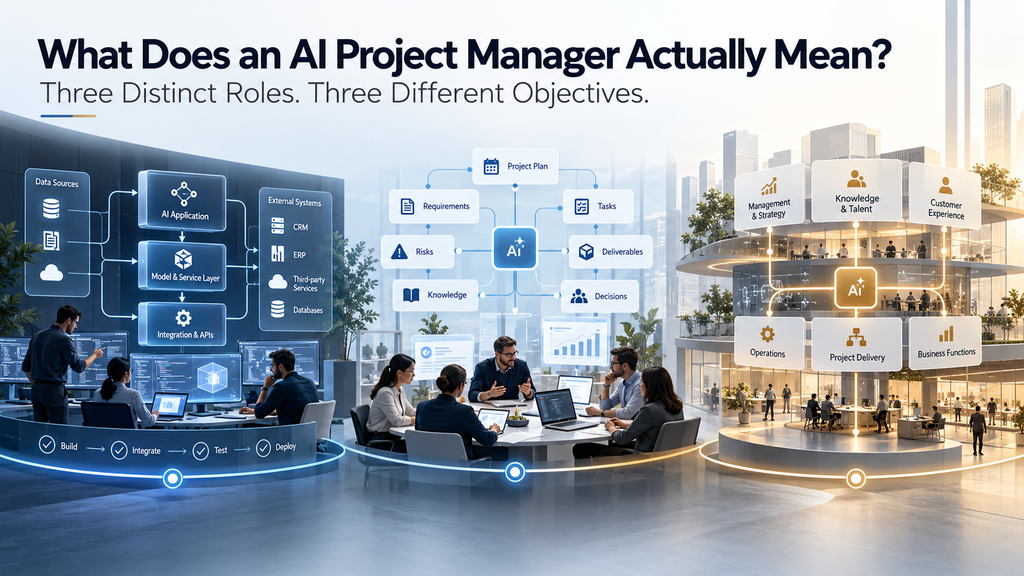
Some people use it to describe a project manager responsible for developing and delivering AI products or solutions. Others mean a project manager who uses AI to assist with project management activities. Still others associate the role with projects involving enterprise AI transformation.
These interpretations may sound similar, but when we look at the actual work involved, the differences become significant.
In my view, understanding what an AI Project Manager actually does begins with distinguishing between these roles.
1. AI Solution Project Manager: Managing Projects That Deliver AI Solutions
The first role involves managing the development and delivery of AI products or solutions.
Examples include developing internal enterprise knowledge bases, building AI Agent applications, deploying private LLM platforms, or integrating AI capabilities into existing business systems.
These projects may involve model selection, system architecture, data preparation, knowledge retrieval, tool calling, workflow design, system integration, testing, validation, and deployment.
The project manager coordinates technical teams, business departments, vendors, and other stakeholders to ensure that the AI solution is delivered according to the agreed scope, schedule, budget, and quality requirements.
Of course, a project manager working on an AI solution may also use AI to support their own management activities. However, this is not the defining characteristic of the role.
Even if the project manager never uses AI to assist with project management, the work remains AI solution project management as long as the project itself involves developing and delivering an AI solution.
Conversely, a project manager who uses AI every day to develop plans, analyze risks, and prepare documentation is not necessarily managing an AI project if the project itself has nothing to do with developing an AI solution.
The key question here is what the project manager is delivering, not how they use AI to manage the project.
This is the fundamental distinction between the first role and the other two.
2. AI-Augmented Project Manager: Changing How Project Management Is Performed
The second role focuses not on whether the project itself involves AI, but on how the project manager uses AI to improve project management.
Examples include using AI to organize meeting minutes, analyze project risks, clarify requirements, generate project documentation, identify gaps in plans, or support progress and issue analysis.
In this case, AI is a tool used by the project manager. It can improve individual productivity, but the fundamental responsibilities of project management do not automatically change.
However, I believe this interpretation can be divided further.
In another scenario, AI is no longer just an assistant used by the project manager personally. Instead, it becomes a capability that runs throughout the project workflow and can be accessed by the entire project team.
For example, the team might use AI Agents to help organize requirements, track action items, analyze risks, review deliverables, maintain project knowledge, or execute certain tasks within predefined rules and permissions.
AI is no longer serving only the project manager. It is supporting the entire project team.
The project manager establishes the relevant boundaries, usage principles, permission rules, and human review mechanisms, while remaining ultimately accountable for project management outcomes. Team members can then use these AI capabilities according to their individual responsibilities and needs.
This is significantly different from individual AI assistance.
The first approach primarily improves one person’s productivity. The second builds a capability that can be shared and used across the project team.
I would consider both scenarios to fall under the broader category of AI-augmented project management, although they represent different levels of application maturity.
What matters is not simply whether a project manager knows how to use AI, but whether AI can evolve from an individual tool into a capability that supports the entire project team.
3. Enterprise AI Transformation Project Manager: Integrating AI into Business and Organizational Operations
The third role is more distinct from the first two.
The focus is neither on whether the project manager uses AI nor necessarily on whether the project delivers an AI product or platform. Instead, it concerns how an organization integrates AI into its business operations, processes, and ways of working.
For example, a company may decide to introduce AI progressively into customer service, internal knowledge management, project delivery, quality management, operational analysis, and decision support.
Such an initiative may involve multiple departments, business processes, and changes to organizational responsibilities, working mechanisms, data management, and employee capabilities.
The objective is to help the organization develop a genuine capability to use AI, rather than simply complete the deployment of a technical system.
In this context, the outcomes may include redesigned business processes, sustainable AI workflows, validated application scenarios, and the associated management and governance mechanisms.
AI technology itself may be only one component of the transformation.
During some phases, the team may not even need to use AI extensively to manage the project. The defining factor is whether the project aims to integrate AI into the organization’s business and operations, rather than which tools the project manager uses.
This role also requires a different combination of capabilities.
Beyond project delivery, the manager needs to understand business operations, cross-functional collaboration, process improvement, organizational governance, change management, and how technical capabilities can translate into tangible business value.
The real objective is not merely to deploy technology, but to help the organization develop a new way of working and a sustainable organizational capability.
That is why I believe enterprise AI transformation project management deserves to be discussed as a distinct area.
4. What Exactly Distinguishes These Three Roles?
Looking at the three roles together, we can see that although they all involve AI, their primary areas of focus are different.
- AI Solution Project Manager: Focuses on managing the development, integration, and delivery of AI products or solutions.
- AI-Augmented Project Manager: Focuses on using AI to improve project management and making AI capabilities available to the wider project team.
- Enterprise AI Transformation Project Manager: Focuses on integrating AI into business processes and organizational operations to build sustainable capabilities.
These roles are not mutually exclusive. The same person may possess capabilities across all three areas, and a single initiative may involve two or even all three.
For example, a project manager leading an enterprise AI transformation initiative might coordinate the development of internal AI applications while also using AI Agents to support project management.
However, this does not mean the three concepts should be treated as interchangeable.
We still need to distinguish what responsibilities a person is performing, what the project is intended to deliver, and what outcome the organization ultimately wants to achieve.
Without these distinctions, the discussion can easily remain at the level of an overly broad label, making it difficult to clarify the actual work, required capabilities, and accountability boundaries.
5. Why I Increasingly Emphasize These Distinctions
I have long believed that many management problems originate from concepts that have not been clearly defined.
When we describe someone as a project manager, we often need to clarify whether they manage an individual project, a program, or a portfolio.
Similarly, when we describe someone as an AI Project Manager, we should ask another question: are they managing the delivery of an AI solution, using AI to improve project management, or driving AI transformation across an organization?
These questions may sound similar, but they correspond to different objectives, responsibilities, and capability requirements.
If a company needs a project manager who can deliver AI products, simply being proficient with AI tools does not demonstrate the technical project delivery capabilities required for that role.
If a company needs someone to integrate AI into its business, experience in delivering AI products alone may not be sufficient to address organizational collaboration, business process redesign, and change management.
Similarly, if an organization wants to transform how its project teams work through AI, a project manager who only knows how to generate documents with AI may not yet have the capabilities required to design team-level AI workflows.
These capabilities can complement one another, but they are not equivalent.
Therefore, when I hear people refer to an “AI Project Manager,” I usually encourage them to clarify which role they actually mean.
My intention is not to impose unnecessary restrictions on the terminology. Rather, I believe that only when the concepts and boundaries are clear can we have a meaningful discussion about the capabilities required, the responsibilities involved, and the value the role can create for an organization.
For me, this is not merely a conceptual discussion.
I am working to combine my accumulated experience in project delivery, project governance, and organizational management with AI applications that I am independently developing. My design direction is guided by the reliability, governance, and operational continuity expected in real enterprise business environments.
On one hand, I am exploring how AI can evolve from an individual productivity tool into a capability that the entire project team can use. On the other, I am investigating how AI Agents and workflows can be integrated into real business and management processes.
My focus is increasingly shifting beyond using AI to complete individual tasks faster. I am more interested in designing the working mechanisms that allow AI to contribute continuously within clearly defined boundaries, rules, and governance requirements.
When AI begins to support project management, enable team collaboration, and become integrated into real business processes, the relationship between project management and AI moves beyond tool usage and into the development of organizational capabilities.
That is the direction I am continuing to explore.