AI becomes valuable when it is embedded into real work—not when it sits beside it.
My AI capability system focuses on designing AI as an operating capability: private deployment, agentic workflows, enterprise knowledge access, tool and system integration, human control, auditability, and reusable workflows that can improve individual work, team execution, and organizational operations.
This is not an “AI tools” page. It is a system for turning AI into operational capability.
The goal is not to collect models, prompts, or chat interfaces. The goal is to connect AI with real workflows, enterprise knowledge, tools, permissions, decisions, and verification so that useful work can actually be executed reliably.
Start from work, not from models.
Identify the business process, decision, handoff, document, or repetitive knowledge task first—then determine where AI can remove friction or add judgment support.
Capability must respect information boundaries.
Sensitive company information, project documents, internal knowledge, permissions, and audit requirements should shape the architecture from the beginning.
Automation does not remove responsibility.
Important outputs require clear human ownership, review points, escalation conditions, and evidence that the workflow performed as intended.
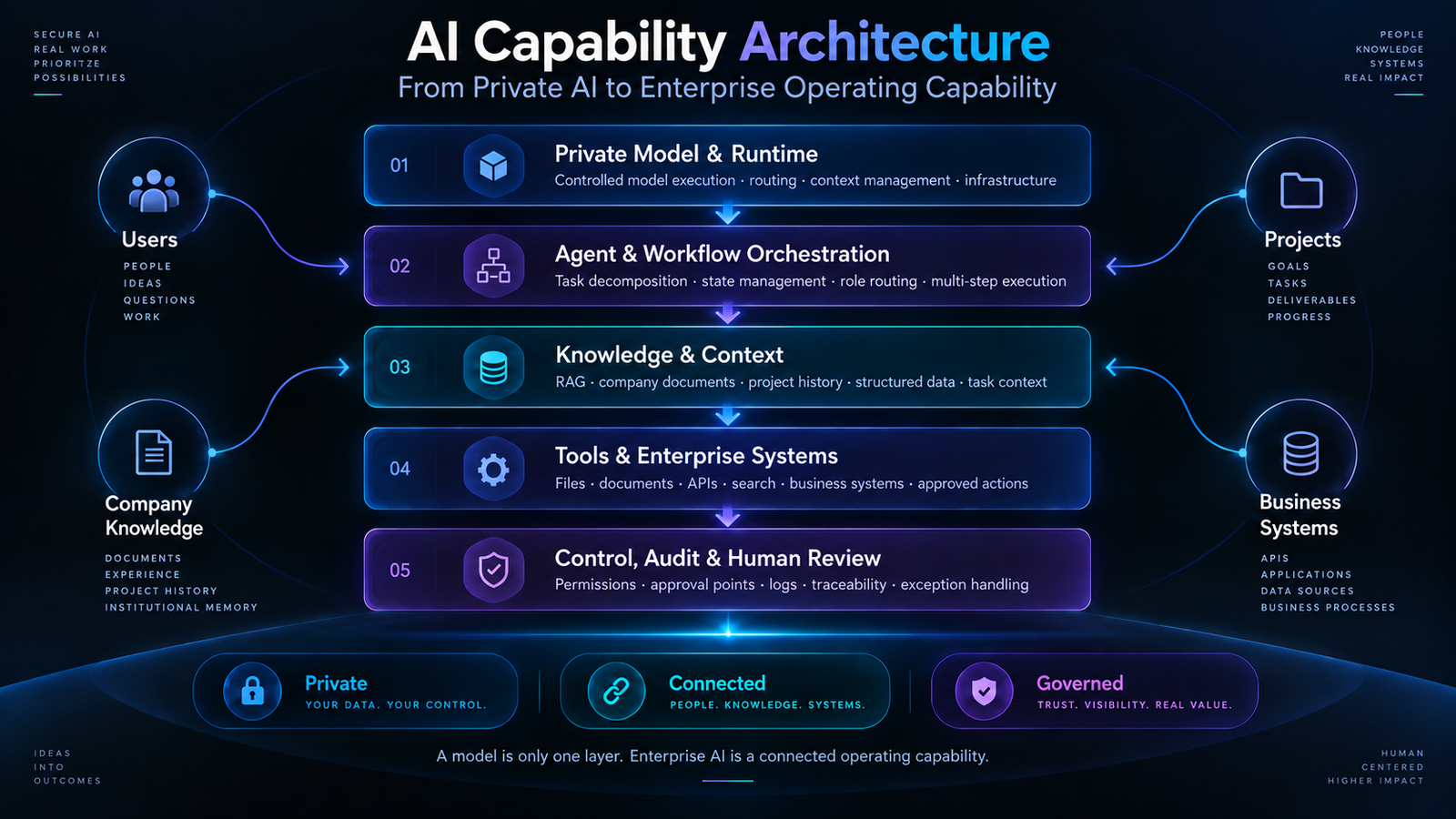
A useful enterprise AI system is a stack of connected capabilities—not a single model.
The model is only one layer. Reliable AI requires infrastructure, workflow orchestration, context, tools, business systems, access control, observability, and human checkpoints working together.
Design the whole chain around the work that needs to happen.
An enterprise AI application should know what task it is performing, which information it is allowed to use, which tools it may call, what output is expected, and when a person must review or intervene.
That is the difference between a useful workflow and an isolated chatbot.
Private Model & Runtime
Local or controlled model execution, model routing, context management, and infrastructure appropriate to the workload.
Agent & Workflow Orchestration
Break work into steps, manage state, assign roles, route tasks, call tools, and coordinate multi-stage execution.
Knowledge & Context
Retrieve relevant company documents, project material, structured data, history, and task context without exposing unrelated information.
Tools & Enterprise Systems
Read files, write documents, search approved sources, call APIs, interact with business systems, and execute permitted actions.
Control, Audit & Human Review
Define permissions, approval points, operation logs, traceability, failure handling, and escalation to people when judgment is required.
Why AI should be designed around workflows, knowledge, systems, and accountability.
This short video explains why model access alone is not enough—and how AI becomes a durable capability when it is embedded into the way work is actually performed.
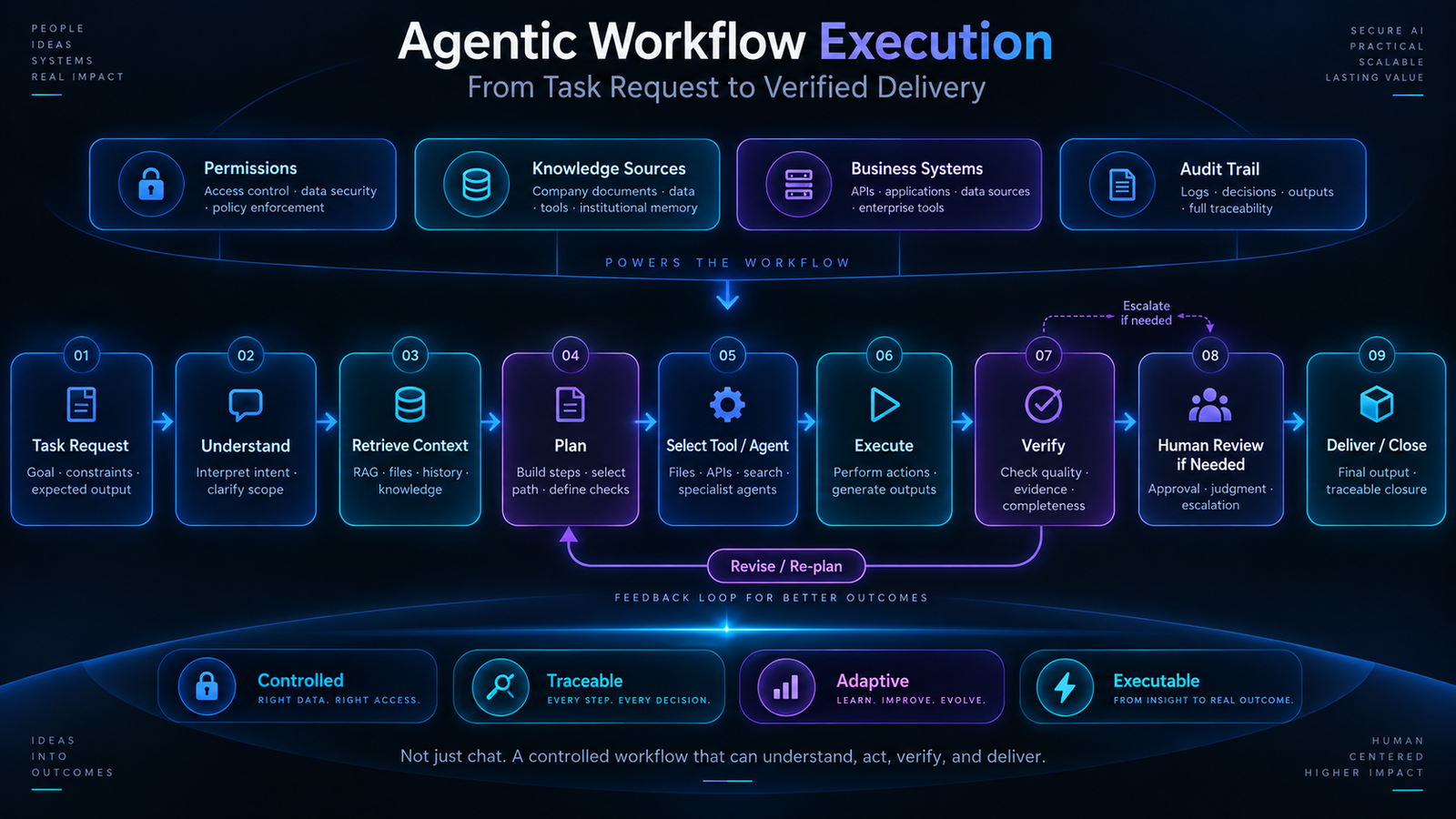
Agents matter when they can move work through a controlled workflow.
A useful agent is not only a conversational interface. It should be able to understand a task, build or follow a plan, access approved context, use tools, produce intermediate outputs, respond to checks, and complete a verifiable result.
Interpret the task.
Identify the objective, constraints, expected output, available context, and required permissions.
Create an execution path.
Break the task into steps, determine dependencies, select tools, and define where review or escalation is needed.
Use tools and systems.
Retrieve information, operate on files, call services, generate deliverables, and coordinate specialized agents where useful.
Check before completion.
Validate outputs, confirm required evidence, handle exceptions, and send high-risk or ambiguous decisions back to a person.
Enterprise AI is only as useful as the context it can safely access.
RAG and enterprise knowledge access should help AI retrieve the right information at the right moment—not simply expose all documents to every task.
Find relevant knowledge.
Search project files, standards, prior deliverables, policies, cases, and structured knowledge according to the current task.
Respect scope and permission.
Limit context according to user identity, project boundary, work mode, information sensitivity, and the minimum data actually needed.
Turn experience into usable context.
Make prior decisions, successful templates, lessons, recurring patterns, and organizational knowledge available to future workflows.
The more AI can do, the more clearly control needs to be designed.
Important enterprise workflows need defined access boundaries, approval points, audit records, exception handling, and a clear answer to one question: when should the system stop and ask a person?
AI adoption should progress from personal assistance to shared organizational capability.
The real transformation is not that one person becomes faster. It is that useful workflows become repeatable, governable, and available across the organization.
Personal AI Assistance
Drafting, analysis, summarization, search, document review, planning, and task support for one person.
Workflow Automation
Repeatable workflows for reporting, document review, QA, coordination, knowledge retrieval, task handoff, and specialist support.
AI Operating Capability
Shared AI infrastructure, permission-aware knowledge, reusable agent workflows, auditability, and integration into organizational management.
AI is independent—but it should strengthen the management systems around it.
AI is not the final stage after PMO. It is a horizontal capability that can enhance project delivery, governance, organizational coordination, and knowledge work at the same time.
One capability, multiple management contexts.
The same AI foundation can support different workflows, data boundaries, user roles, and decision patterns without forcing the organization into a single monolithic process.
The target is not “more AI.” The target is better work.
AI should earn its place by improving speed, quality, consistency, knowledge reuse, visibility, or the ability to execute work that was previously too expensive or fragmented.
Less repetitive work
Move routine reading, comparison, drafting, extraction, formatting, and follow-up into controlled workflows.
Better information quality
Reduce context loss, inconsistent reuse, missed requirements, fragmented knowledge, and manual copy-paste errors.
Faster decision preparation
Bring together evidence, alternatives, risk, context, and prior knowledge before a person makes the final decision.
Reusable organizational capability
Turn successful workflows, methods, knowledge, and decision patterns into systems that can be used again.
AI Capability is neither a replacement for management nor a collection of disconnected tools.
It is the technical and operational layer that helps people, workflows, knowledge, systems, and decisions work together with greater speed and consistency—while keeping responsibility, permission, and verification explicit.
Design AI around the work, connect it to the organization, and govern the actions it can take.
That is how AI moves from a personal productivity tool to a durable enterprise capability.