Connect projects, departments, priorities, resources, and management decisions into one operating system.
My PMO and organizational management approach focuses on the coordination layer above individual projects: aligning programs and portfolios, managing cross-functional dependencies, supporting resource and priority decisions, standardizing management practices, and turning project information into useful management insight.
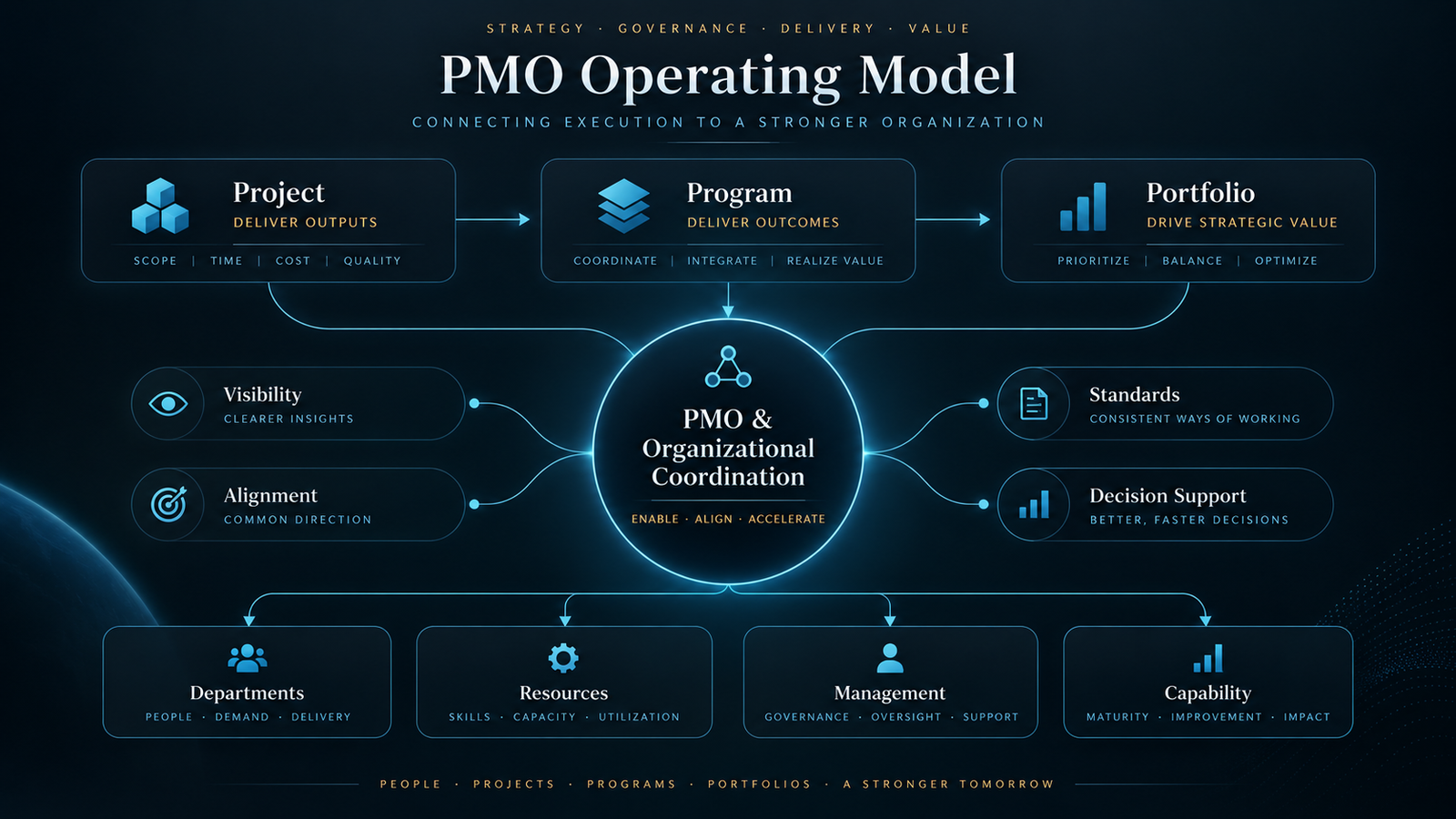
This is not enterprise executive management. It is the coordination and operating layer around multiple projects and departments.
The focus is not ownership of corporate strategy, P&L, or business-unit leadership. The focus is making work across projects, programs, portfolios, departments, resources, standards, and management reporting more coherent and more usable for decision-making.
PMO Operations
Define management rhythms, information standards, reporting structures, escalation paths, and coordination mechanisms.
Program & Portfolio Coordination
Connect related projects, dependencies, priorities, resource constraints, and shared outcomes across a broader delivery landscape.
Cross-functional Management
Coordinate work that crosses departments, roles, vendors, or professional boundaries when no single team controls the whole result.
Management Decision Support
Turn fragmented project information into clearer signals for prioritization, escalation, resource decisions, and management discussion.
Six operating components connect project execution with organizational coordination.
The PMO layer should not become another bureaucracy. Its purpose is to create shared visibility, reduce cross-project friction, improve decision quality, and make useful management practices reusable.
Multiple projects require management of relationships, not only individual status.
Portfolio coordination is not simply collecting project reports. It is identifying where priorities conflict, resources collide, dependencies cross project boundaries, and management decisions are required.
Aggregate only what changes a decision.
A PMO should not create reporting volume for its own sake. Information becomes valuable when it clarifies priority, risk, dependency, resource pressure, or the need for management intervention.
The goal is a portfolio view that makes conflicts and decisions visible without losing the context of the individual projects underneath.
Which work matters most now?
Clarify business importance, urgency, constraints, and sequencing when demands compete.
Where can one project block another?
Identify shared systems, data, teams, vendors, environments, and decisions that create cross-project coupling.
Where is capacity under pressure?
Surface conflicts around scarce people, time, tools, environments, budget, or external support.
Which issues require management attention?
Separate operational noise from decisions that genuinely need escalation, trade-off, or leadership input.
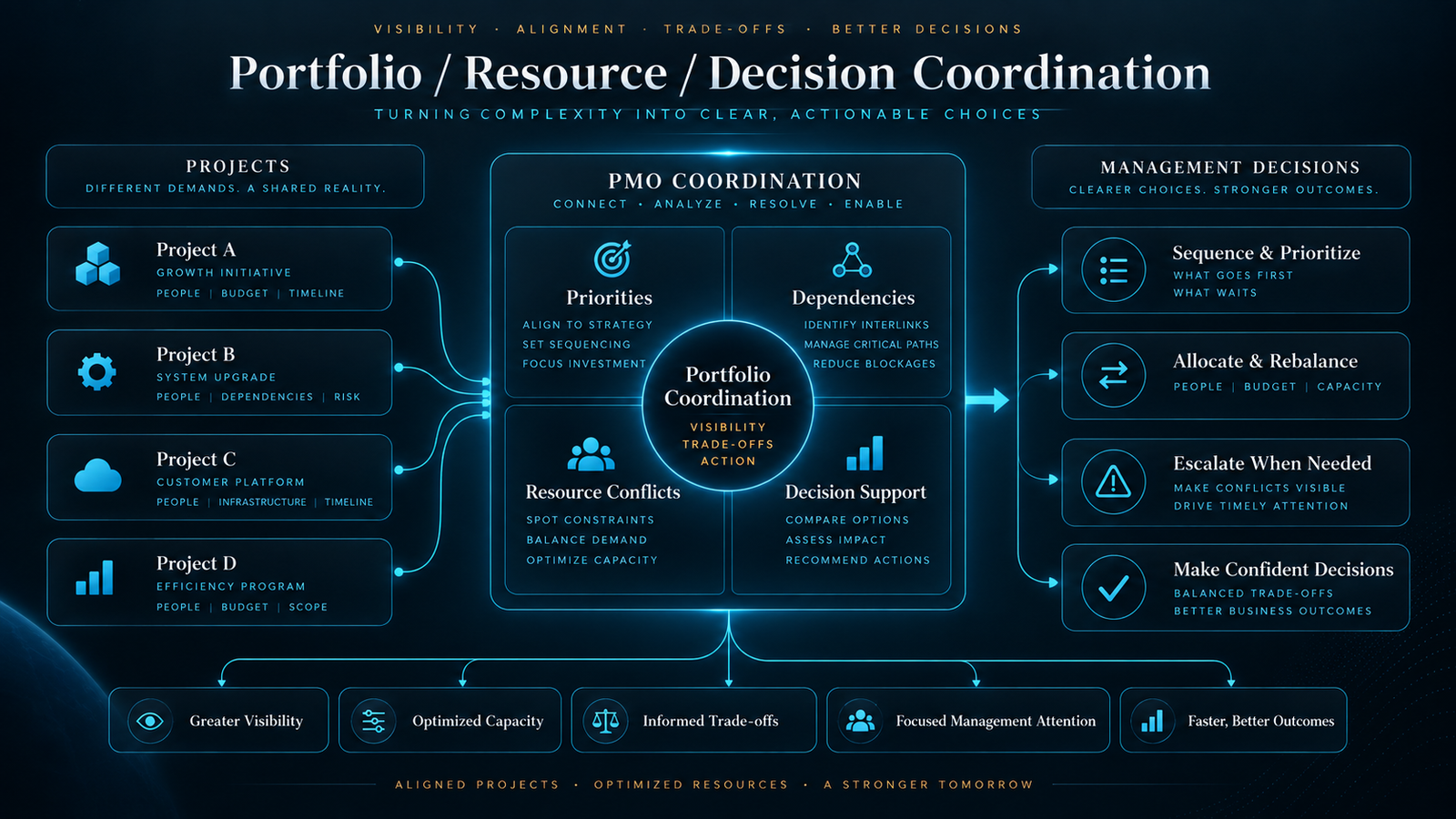
Resource management is not only assignment. It is the management of competing demand.
When multiple projects depend on the same people, tools, budget, environments, or external support, PMO coordination helps make the conflict visible and creates a basis for trade-off.
Shared specialists
Identify overloaded roles, scarce expertise, and critical-person dependency.
Competing schedules
Sequence work when several priorities demand the same window or delivery capacity.
Funding constraints
Support prioritization when not every initiative can receive equal investment.
Shared infrastructure
Coordinate access to environments, equipment, platforms, or technical support.
Vendor capacity
Manage dependencies on third parties whose availability affects multiple workstreams.
Decision bandwidth
Escalate only issues that genuinely require higher-level trade-off or intervention.
Good PMO reporting should reduce decision friction, not increase information volume.
The value of management reporting is not in producing more slides. It is in making the current state, deviation, options, impact, and required decision clear enough for management to act.
Organizational capability grows when useful practices become reusable.
PMO should help successful patterns survive beyond the individual project without turning experience into rigid bureaucracy.
Experience
Observe what actually worked or failed.
Pattern
Separate reusable patterns from context-specific details.
Standard
Convert useful patterns into lightweight guidance or tools.
Adoption
Use the practice across relevant projects and teams.
Capability
Retain the learning as organizational capability.
PMO & Organizational Management coordinates the operating environment above individual projects.
It does not replace project management, governance, or executive leadership. It connects them by creating shared visibility, coordination mechanisms, prioritization, resource alignment, standards, reporting, and reusable management capability.
Make the whole system visible enough to coordinate—and simple enough to act.
The PMO layer creates value when it helps projects and departments align without becoming another layer of unnecessary administration.