Elijah Agile Delivery

Project Management System

Choosing the right delivery approach between planning and change

Project Management System

My project management system is not centered on one fixed method. It is centered on project goals, delivery constraints, risk characteristics, and acceptance outcomes.

In real projects, I am familiar with both traditional waterfall delivery and agile management. I do not simply believe that waterfall is outdated, nor do I believe that agile applies to every situation. Effective project management should first understand the project itself, then choose the right method.

For me, mature project management is not about standing on the side of waterfall or agile. It is about building balance between planning and change: giving the project clear boundaries while keeping the ability to adjust continuously; valuing staged deliverables while also valuing process feedback; pursuing planned delivery while avoiding the risk of moving efficiently in the wrong direction.

Core View

My Core Judgment

Project management is not about choosing a label. It is about finding the most effective delivery path in a specific context.

Traditional Planning

Use waterfall to manage boundaries

When requirements are stable, contract boundaries are clear, approval processes are strict, and acceptance criteria are explicit, the traditional waterfall model still has value.

Scope / Plan / Milestones / Deliverables / Acceptance basis

Agile Feedback

Use agile to manage uncertainty

When requirements change, customer understanding needs continuous calibration, system integration is complex, and feedback risk is high, agile methods have stronger advantages.

User stories / Iteration planning / Incremental demos / Continuous feedback / Priority management

Hybrid Delivery

Pursue the best fit in context

Use traditional project management to keep the project under control, and use agile feedback mechanisms to reduce deviation, so the project has both planning discipline and adaptability.

Boundary control / Batch delivery / Risk visibility / Stage validation / Continuous correction

01 / Waterfall

The value of the traditional waterfall model

How I Understand the Traditional Waterfall Model

The value of the traditional waterfall model is that it can establish clear sequence, boundaries, and responsibilities for a project.

In many public sector, government, and system integration projects, projects are often strongly constrained by contracts, budgets, approvals, procurement, acceptance, and documentation archiving. These projects are not suitable for completely removing stage boundaries, nor are they suitable for ignoring formal deliverables and acceptance milestones.

In this context, the waterfall model can help a project maintain basic order: clarify project scope and contract boundaries, establish stage plans and milestones, define outputs for each stage, control the critical path and external dependencies, and provide a basis for acceptance, audit, and archiving.

But the problems of the waterfall model are also obvious. If early requirement understanding is inaccurate and deviations are discovered only later, rework costs will be high. If testing and acceptance are pushed too far toward the end, risks will also be exposed in a concentrated way. If customers only participate in confirmation at the end of each stage, the team may move in the wrong direction for a long time.

Therefore, I do not understand waterfall as simply completing all stages in sequence. I care more about how to introduce feedback, inspection, and validation earlier while preserving stage plans and acceptance boundaries.

Scenarios suitable for waterfall thinking

  • Requirements are relatively stable
  • Contract boundaries are clear
  • Approval processes are strict
  • Stage deliverables are clear
  • Acceptance criteria are explicit
  • Documentation and archiving requirements are high

Issues to watch carefully

  • Feedback cycles are too long
  • Testing and acceptance happen too late
  • Requirement deviations are exposed only in later stages
  • Customer confirmation is concentrated at stage endings
  • The plan appears stable while actual risks are hidden

02 / Agile

The value of agile management

How I Understand Agile Management

The value of agile management is not merely rapid iteration. It is about using shorter feedback cycles so the team can discover misunderstandings, risks, and quality issues earlier.

In projects where requirements are not fully clear, customer expression changes, system integration is complex, and business rules need continuous confirmation, relying entirely on one-time requirement confirmation at the beginning creates high risk.

Agile methods can help projects build stronger adaptability: use user stories to clarify real needs, use iteration planning to organize short-cycle delivery, use incremental demos to continuously calibrate understanding, use continuous feedback to expose deviations earlier, use priority management to control scope and rhythm, use Kanban or task boards to improve transparency, and use continuous acceptance to reduce late-stage rework.

But I also do not believe agile can solve every problem. If a team only mechanically holds stand-ups, uses boards, and applies agile terminology without truly improving requirement understanding, collaboration transparency, feedback speed, and delivery quality, then this kind of agile is only a formality.

The agile I understand is not about cancelling plans or weakening management. It is about allowing plans to be continuously corrected based on real feedback, making risks appear earlier, and making delivery outcomes verifiable earlier.

Scenarios suitable for agile thinking

  • Requirements are changing
  • Customer understanding needs continuous calibration
  • System integration is complex
  • Feedback risk is high
  • Quality problems are likely to be exposed late
  • Stage-based demonstrations and confirmations are needed

The agile value I focus on

  • Discover deviations earlier
  • Shorten feedback cycles
  • Improve collaboration transparency
  • Continuously calibrate requirement understanding
  • Reduce concentrated late-stage rework
  • Continuously verify delivery outcomes

03 / Hybrid Delivery

Use waterfall to manage boundaries, and agile to manage uncertainty

Why I Use Hybrid Project Management

Real projects are rarely purely waterfall, and rarely purely agile.

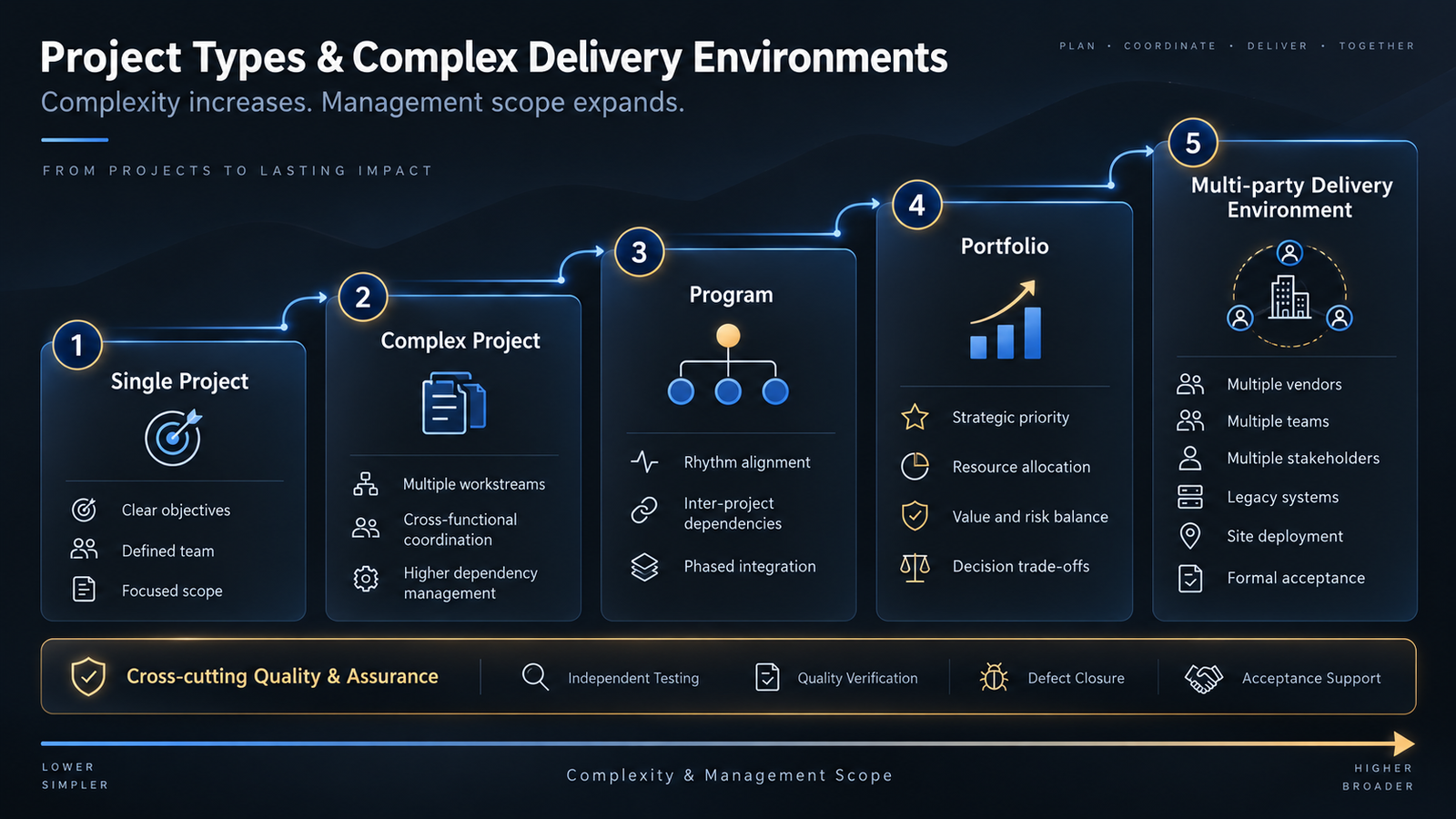
Many projects have both contract and acceptance constraints, as well as requirement changes and integration risks. They need overall plans and milestones, but also need stage-based feedback and flexible adjustment. They must be accountable to customers, vendors, teams, and acceptance stakeholders, while also dealing with uncertainty from site conditions, interface integration, equipment arrival, data quality, and cross-department collaboration.

Therefore, I prefer to use hybrid project management. My basic idea is: use waterfall to manage boundaries, and use agile to manage uncertainty.

It can also be expressed this way: use traditional project management to keep the project under control, and use agile feedback mechanisms to reduce project deviation.

My Hybrid Management Layers

  1. Project boundariesScope, contract, budget, milestones, and acceptance requirements. This layer needs to remain clear and stable.
  2. Delivery rhythmTask decomposition, batch implementation, staged integration, and staged acceptance. This layer needs a reasonable rhythm based on project conditions.
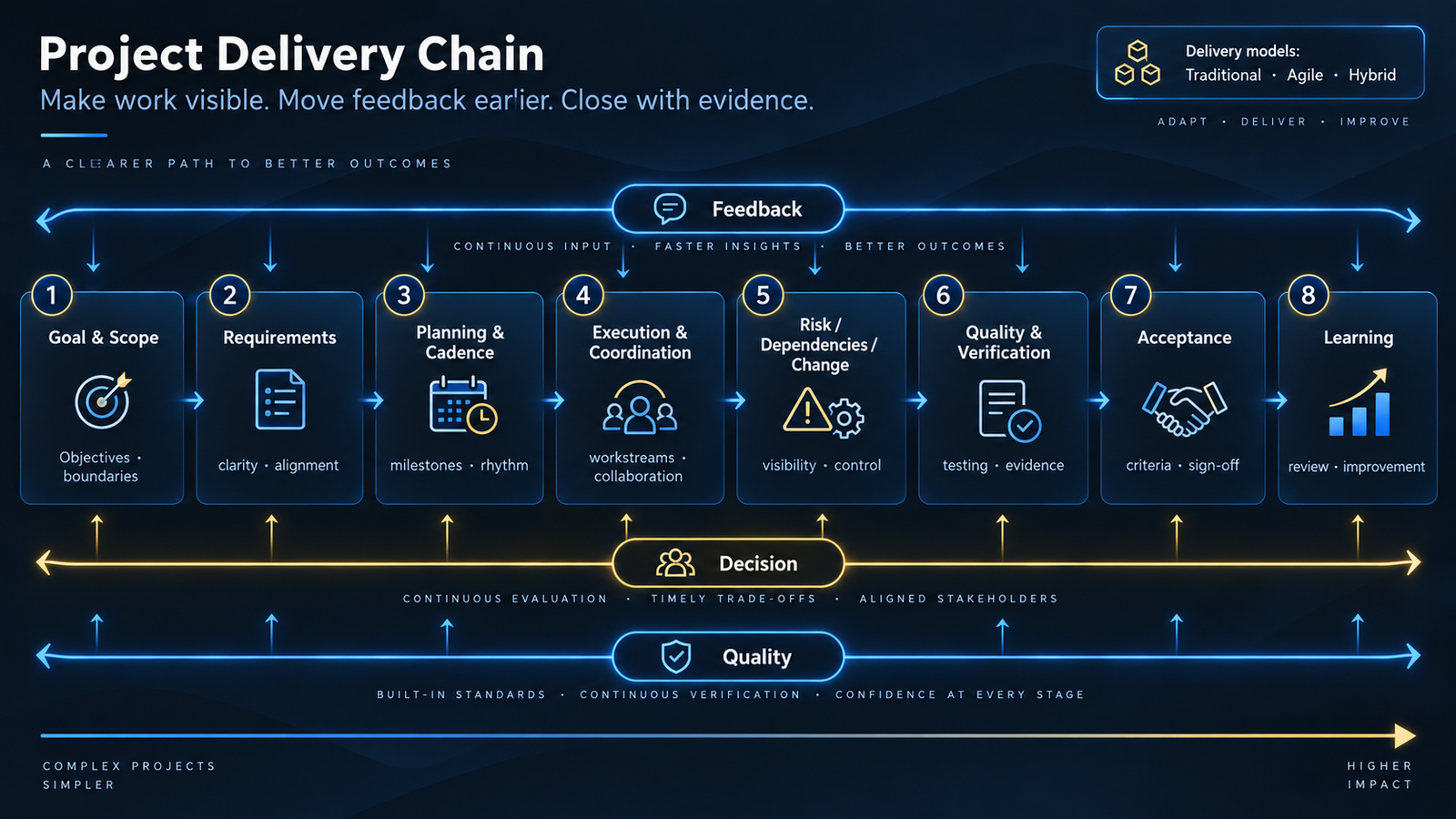
  3. Feedback mechanismReview demos, customer confirmation, testing feedback, and issue closure. This layer should happen as early as possible to avoid discovering problems only at the end.
  4. Risk controlCritical paths, external dependencies, vendor collaboration, interface issues, and quality problems. This layer needs continuous visibility and dynamic adjustment.

Decision Framework

My Project Management Decision Framework

When choosing a management approach, I usually first judge several questions.

Are the requirements stable?

If requirements are relatively stable and acceptance criteria are clear, a stronger stage plan can be used. If requirements contain uncertainty, user stories, prototype confirmation, incremental demos, or stage reviews should be introduced to shorten the feedback cycle.

How involved is the customer?

If the customer can only participate at key milestones, then early scope and document confirmation need to be stricter. If the customer can participate continuously, short-cycle demos and feedback can make requirement understanding more accurate.

Does the project have strong external dependencies?

System integration, hardware installation, data migration, interface integration, vendor delivery, and similar factors can all create external dependencies. The stronger the external dependencies, the more important it is to identify the critical path early and reduce concentrated risk through batch delivery and stage validation.

Are quality risks likely to be exposed late?

If quality issues are likely to be exposed only during testing or acceptance, testing cannot wait until the end. Stage-based testing, integration validation, defect tracking, and continuous acceptance are needed to move quality checks earlier.

Is the project suitable for batch delivery?

If the project can be split by region, module, equipment batch, function, or interface scope, batch delivery and pipeline-style execution can be used. This allows installation, debugging, testing, and acceptance to form a more continuous rhythm instead of being piled up at the end.

Delivery Practices

My Hybrid Delivery Practices

Establish clear boundaries early

This includes project goals, scope, contract constraints, key stakeholders, deliverables, stage plans, acceptance criteria, and major risks. This step leans toward traditional project management. Its purpose is to give the project basic order and prevent ambiguity and confusion from the start.

Build short-cycle feedback in the middle stage

This includes requirement clarification, prototype confirmation, user story decomposition, stage reviews, incremental demos, task boards, and continuous communication. This step leans toward agile management. Its purpose is to reduce misunderstanding and help customers and teams discover problems earlier.

Execute through batch delivery

For complex implementation projects, I try to avoid the approach of completing everything before unified debugging. If conditions allow, I prefer to proceed by region, module, batch, or priority, so part of the work can be installed, debugged, tested, and accepted earlier.

Move testing and acceptance earlier

Quality should not be checked only at final acceptance. I focus on whether requirements, design, implementation, integration, testing, and acceptance form a continuous chain, so quality issues can be discovered and corrected earlier.

Continuously manage risks and dependencies

During project execution, I continuously focus on critical paths, cross-department collaboration, vendor delivery, interface integration, site conditions, customer confirmation, and resource conflicts. These issues cannot be solved simply by scheduling. They need continuous tracking, adjustment, and closure during execution.

Success Definition

How I Understand Project Success

I believe project success is not only about finishing on time, nor only about submitting documents or passing acceptance.

Business goals

The delivered result matches real business goals, rather than only completing a task list.

Shared understanding

The customer and the team share the same understanding of scope and acceptance criteria.

Risk handling

Key risks are identified early and handled during the process.

Stable quality

Quality issues are not accumulated until the end, but are continuously exposed and corrected during the process.

Issue closure

Important decisions and issues are recorded, assigned, tracked, and closed.

Capability accumulation

Project experience can be turned into capability for the next delivery.

If a project is barely completed, but the process heavily depends on firefighting, problems cannot be converted into reusable experience, and the team does not build better capability, then its management value is incomplete.

Keywords

My Project Management Keywords

Clarity

Before the project starts, make goals, scope, responsibilities, boundaries, and acceptance criteria clear.

Rhythm

Use appropriate milestones, iterations, batches, and checkpoints to create a stable project rhythm.

Feedback

Use reviews, demos, testing, integration, and communication to expose deviations earlier.

Risk

Keep the critical path, external dependencies, quality risks, and acceptance risks continuously visible.

Collaboration

Allow customers, teams, vendors, and acceptance stakeholders to work from the same information base.

Verification

Continuously inspect delivery outcomes during the process, instead of confirming everything only at the end.

My project management system does not try to prove that one method is always correct.

The traditional waterfall model has its value in order, and agile management has its value in feedback. What truly matters is understanding the environment, constraints, and uncertainty of the project, then choosing the right management combination.

The core of project management is not applying a method mechanically. It is about enabling complex work to be completed in a more controllable, transparent, and verifiable way.