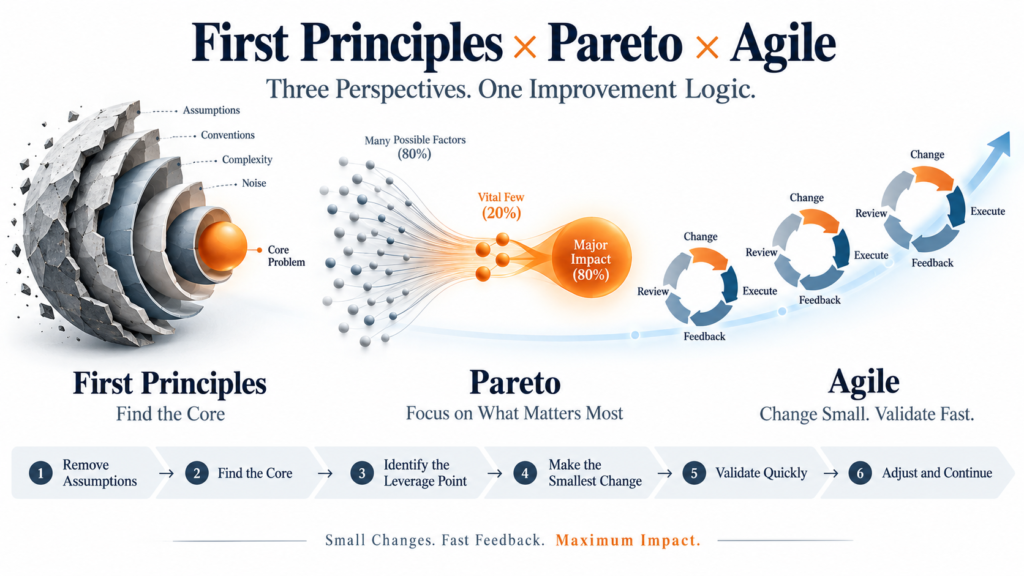
Recently, I have been thinking again about first-principles thinking, the Pareto principle, and Agile. The more I look at them, the more I feel that they are closely connected.
On the surface, they come from very different fields.
First-principles thinking is a way of reasoning that breaks a problem down to its fundamental facts. The Pareto principle is a way of looking at how effort and outcomes are distributed. Agile, meanwhile, is more commonly associated with project management and product development, emphasizing short cycles, fast feedback, and continuous adjustment.
But if we look one level deeper, I think they all point in a very similar direction:
Do not try to change everything at once. Find what truly matters, make the smallest practical change, validate it quickly, and use that change to create a larger improvement.
First Principles: Find What Cannot Be Replaced by Assumptions
The biggest lesson I take from first-principles thinking is not simply to “break a problem into smaller pieces.”
It is to keep asking:
Which parts are based only on habit?
Which assumptions exist because someone told us that this is how things should be done?
And which parts are actual facts or constraints that cannot be ignored?
When a problem becomes complex, it is easy to be constrained by existing processes, experience, policies, or industry conventions.
“We have always done it this way” can gradually turn into “this is the only way it can be done.”
First-principles thinking challenges that inertia.
It asks us to temporarily set aside existing answers, reduce the problem to its most fundamental facts, and then ask:
If I were designing the solution again based only on these facts, what would I do?
In that sense, first-principles thinking is not about finding more methods.
It is often about removing unnecessary assumptions.
Once a complex problem is broken down this way, the real issue often becomes much easier to see.
Pareto: Not Every Problem Deserves the Same Amount of Effort
Once we understand the problem, the next question is:
What should we solve first?
This is where the Pareto principle gives me another useful perspective.
In many situations, results are not distributed evenly. A relatively small number of factors may determine a large part of the outcome, and a relatively small number of problems may create most of the loss.
The 80/20 ratio does not have to be mathematically exact every time.
The more important idea is this:
Do not assume that everything is equally important.
If a project has ten problems, that does not mean all ten deserve the same amount of time.
If a process has dozens of steps, improving every step does not necessarily create the same level of benefit.
What really matters is finding the points with the greatest leverage:
Which issues create most of the rework?
Which process step creates the longest waiting time?
Which interface causes the most communication overhead?
Which constraint, once removed, would improve several downstream activities at the same time?
First-principles thinking helps me understand what the real problem is.
Pareto thinking then asks:
Which part of that problem is most worth changing first?
Agile: Keep Change Small Enough to Validate Quickly
Even after we identify the most important issue, there is still another common risk:
Trying to change too much at once.
Many improvement initiatives fail not because the overall direction is completely wrong, but because too many processes, roles, rules, and tools are changed at the same time.
When that happens, even if the outcome changes, it becomes difficult to know what actually caused the improvement.
This is where Agile completes the picture for me.
Do not try to design a perfect new system all at once.
Make one sufficiently small change.
Execute it.
Observe the result.
Get feedback.
Review what happened.
Confirm whether the original problem actually improved.
Then decide what to change next.
This is why I increasingly value short cycles, small batches, and continuous feedback.
The real value is not simply speed.
It is this:
Make each change small enough that you can quickly understand whether it actually worked.
If it works, expand it.
If it does not work, adjust it.
If new facts appear, reassess the situation.
In this way, the uncertainty of a large-scale transformation can be broken down into a series of smaller, testable decisions.
Three Different Perspectives on the Same Improvement Logic
This is why I no longer see first-principles thinking, Pareto, and Agile as three completely separate ideas.
To me, they are three different perspectives on the same underlying logic.
First principles asks:
What is the real problem?
Pareto asks:
Which part matters most?
Agile asks:
How should we validate the change?
Put together, they form a very natural improvement chain:
Remove assumptions → Find the core issue → Identify the leverage point → Make the smallest change → Validate quickly → Adjust based on results
For me, this logic is more important than memorizing any single framework.
Real working environments will never operate exactly as a book describes them.
Projects differ. Organizations differ. Teams differ. Resources differ. Constraints differ.
But the logic of first identifying the real problem, then finding the most important part, and finally validating a change with the lowest practical cost is useful in many environments.
This Is Also the Biggest Change in How I Think and Work
Looking back at how I have learned and worked over the past few years, I think the biggest change is not that I have learned more frameworks.
In fact, it is almost the opposite.
I am increasingly less willing to start with a large framework and use it to cover the entire problem.
In the past, when facing a complex issue, it was easy to think:
Do we need a more complete management system?
Should we redesign the whole process?
Should we try to solve every problem together?
Now I am more likely to ask:
What is the core factor actually affecting the outcome?
Then:
What is the smallest thing I can change?
And finally:
After making that change, did the facts actually improve?
If not, adjust again.
If it works, keep it and move to the next step.
This way of thinking has gradually influenced how I approach project management, process improvement, organizational governance, and AI application design.
I increasingly believe that many complex problems do not require a massive solution from the very beginning.
Effective improvement often comes from a very limited number of actions.
Find the right place.
Make a sufficiently small change.
Get real feedback as quickly as possible.
Then make the next decision based on the new facts.
If I had to reduce the common logic behind first principles, Pareto, and Agile to one sentence, I would put it this way:
Find the fundamental facts, focus effort where it has the greatest impact, and keep moving through the smallest, fastest, and most testable changes possible.
That has become one of the clearest changes in how I learn, work, and improve.