Reliable delivery comes from making work visible, dependencies explicit, feedback early, and acceptance clear.
My project management system is built around the fundamentals that remain constant across Predictive, Agile, and Hybrid delivery: objectives, scope, requirements, planning, coordination, risk, quality, integration, validation, and closure.
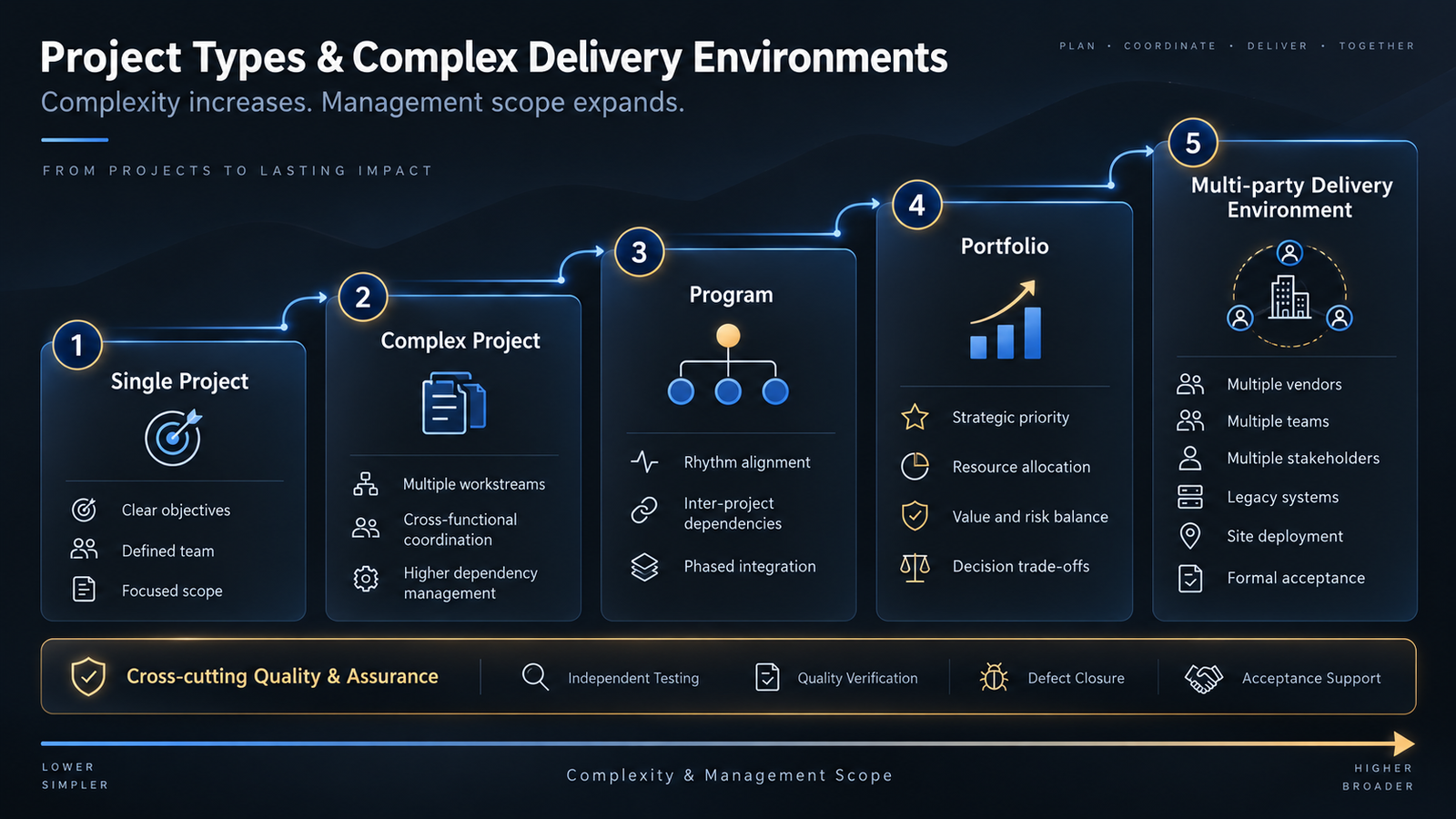
The management method changes with context. The operating principles do not.
Different projects need different structures, cadences, and levels of control, but several principles consistently improve delivery reliability.
Context first
Select the delivery model and management depth according to uncertainty, dependencies, integration complexity, stakeholder structure, and acceptance conditions.
Visibility before control
Make plan, risk, dependencies, issues, decisions, change, and quality visible before trying to control them.
Feedback before late surprise
Move integration, review, testing, and acceptance feedback earlier so problems are discovered while they are still inexpensive to correct.
Acceptance designed early
Define evidence, standards, verification paths, and acceptance conditions before the end of delivery.
Frameworks serve the context. Delivery must remain reliable.
This video explains how I decide whether a project needs Predictive, Agile, Hybrid, or a more structured multi-party delivery approach—and why complexity should shape the management system.
Eight components form the core of the delivery operating system.
These components are not tied to one framework. Their depth and cadence change, but the need to manage them remains.
Objectives & Scope
Clarify what outcome is required, what is included, what is excluded, and what success means.
Requirements
Manage requirement source, interpretation, priority, confirmation, traceability, and change.
Planning
Build a realistic delivery path using milestones, cadence, dependencies, capacity, and decision points.
Coordination
Connect owners, teams, vendors, stakeholders, interfaces, and handoffs across the delivery environment.
Risk & Change
Make uncertainty, issues, change impact, and management responses visible and actionable.
Quality
Define quality criteria, verification activities, defect handling, evidence, and readiness before final acceptance.
Integration
Manage technical and organizational interfaces so independently delivered parts work together as a system.
Validation & Closure
Confirm results against requirements and acceptance conditions, then close issues, evidence, decisions, and lessons.
Predictive, Agile, and Hybrid are delivery approaches—not professional identities.
PMP, PMI-ACP, and PSM II reflect breadth across project management, agile practice, and Scrum, but the delivery model still needs to be selected according to context, uncertainty, dependencies, governance requirements, and acceptance conditions.
Plan-driven delivery
Use stronger upfront planning, sequencing, baselines, formal controls, and structured acceptance where the environment requires them.
Feedback-driven delivery
Use shorter feedback loops, incremental validation, evolving detail, and adaptive planning where uncertainty and learning are high.
Context-driven combination
Combine predictive control and agile feedback where different parts of the same delivery environment require different operating rhythms.
Predictive, Agile, and Hybrid organize the same fundamental work at different scale and cadence.
The lifecycle should fit the delivery context. What changes is how work is grouped, sequenced, reviewed, and adapted—not the need to plan, design, execute, validate, and learn.
Large stages, concentrated work
Suitable where scope, standards, dependencies, procurement, regulatory controls, or formal acceptance require stronger planning discipline, phase boundaries, and planned sequencing.
Small batches, frequent feedback
Suitable where uncertainty is high, feedback can be obtained quickly, and incremental value can be delivered and adjusted frequently.
Different rhythms inside one delivery system
Suitable where some work needs formal planning and acceptance while other work benefits from iterative discovery and delivery.
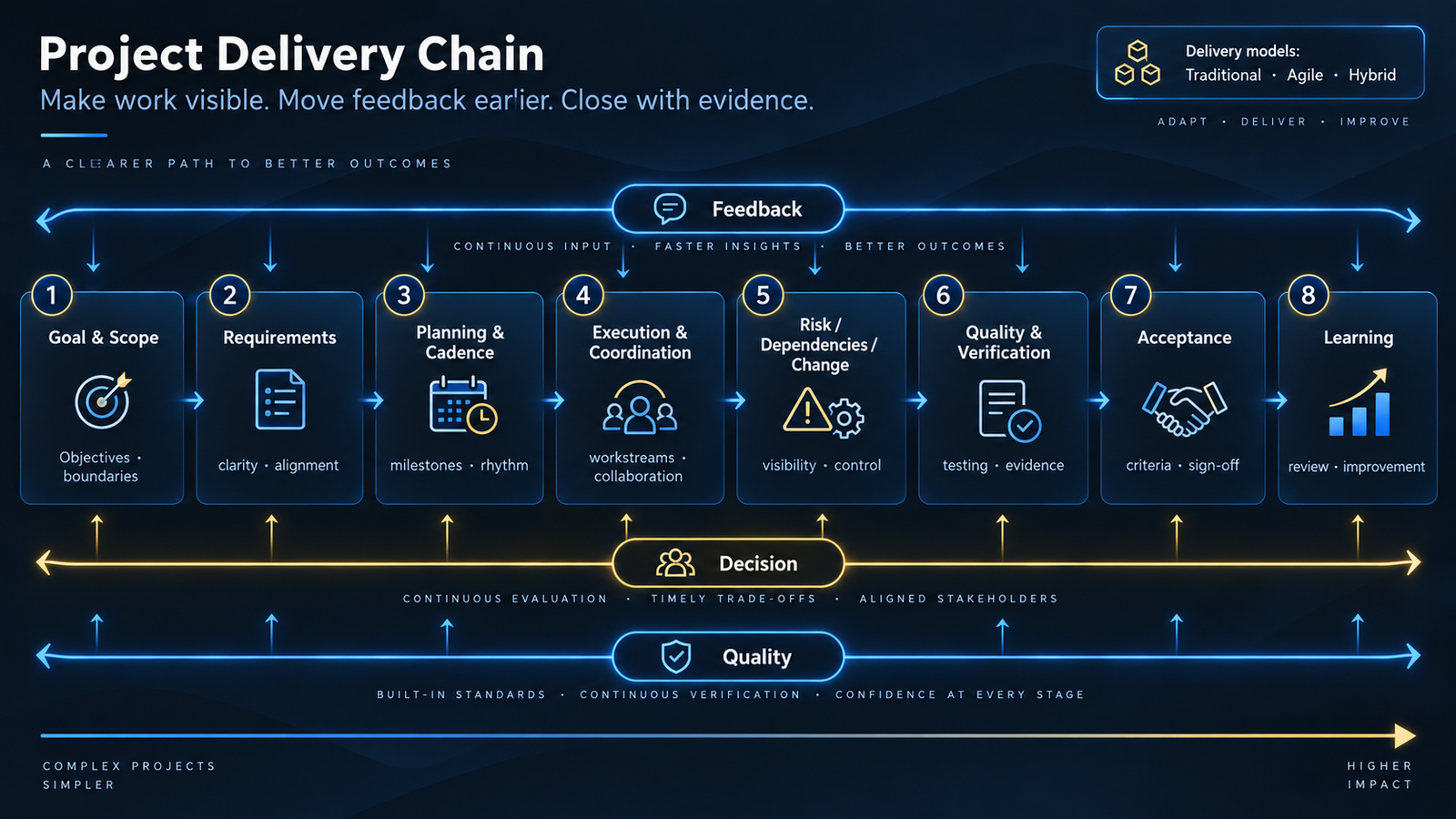
Control works best when the information needed for action is always visible.
The objective is not to produce more project artifacts. It is to keep the most important management signals current enough to support timely action.
What should happen next?
Milestones, cadence, ownership, sequencing, and current commitments.
What could affect the result?
Uncertainty, probability, impact, response, trigger, and escalation.
What is already blocking delivery?
Current problem, owner, action, deadline, dependency, and closure condition.
What changed and what does it affect?
Requirement, scope, schedule, quality, cost, dependency, or acceptance impact.
What has been decided?
Decision, rationale, owner, timing, affected work, and follow-up.
How do we know it is acceptable?
Criteria, review, verification evidence, defects, readiness, and closure.
Make work visible. Move feedback earlier. Close with evidence.
This video explains how planning, coordination, risk, quality, integration, and acceptance are connected—and why early integration and phased validation reduce late delivery surprises.
Parallel delivery becomes safer when integration and validation move forward with the work.
In complex multi-party delivery, waiting until all components are “finished” before integration creates late risk. A better approach is to expose interfaces early, integrate incrementally, and validate in stages.
Parallel workstreams
Different teams deliver components, data, infrastructure, software, testing, or operational preparation in parallel.
Early interface confirmation
Clarify dependencies, inputs, outputs, technical interfaces, responsibilities, environments, and acceptance expectations before the end.
Incremental integration
Integrate and test available components as early as practical instead of waiting for a single final integration event.
Phased validation
Validate completed scope in stages so defects, gaps, evidence, and acceptance issues are resolved earlier.
Project Management handles normal delivery. Structural dysfunction belongs elsewhere.
The delivery operating system should solve routine project problems. When the same failure repeats, responsibility remains structurally unclear, decision paths stay broken, or multiple projects show the same pattern, the issue should move beyond ordinary project control.
Choose the method for the context. Keep the delivery system visible, adaptive, and verifiable.
Reliable project management is less about defending one framework and more about building the management conditions that allow the project to finish successfully.