When recurring problems survive normal project management, I look beyond the symptom.
My governance system starts from observable phenomena, identifies and verifies likely root causes, selects the appropriate governance logic and standard tool, and converts the result into accountable actions that can be tracked, escalated, verified, and closed.
Governance begins when routine project control is no longer enough.
Not every project issue is a governance issue. Governance becomes necessary when the same dysfunction repeats, crosses boundaries, survives normal control, or points to a deeper problem in roles, flow, standards, capability, resources, or decision-making.
Normal delivery problems
Handle through ordinary project controls when the system itself is still functioning.
- Isolated schedule deviation
- Normal requirement change
- One-time quality issue
- Ordinary coordination delay
- Manageable project risk
Recurring or structural dysfunction
Escalate the problem when symptoms repeat or expose deeper operating weaknesses.
- Same problem repeatedly appears
- Responsibility remains unclear
- Decisions repeatedly stall
- Waiting and rework become structural
- Multiple projects show the same pattern
Four governance logics organize how corrective action is selected.
The governance logic helps explain what kind of intervention is needed before choosing the specific tool or action.
Align
Resolve ambiguity around objectives, requirements, standards, and what “good enough” actually means.
Streamline
Correct broken flow, unclear handoffs, unclear ownership, waiting, duplication, and inefficient process movement.
Enable
Address capability, resource, tool, equipment, or support gaps that make delivery impossible or unreliable.
Close the Loop
Resolve low-efficiency communication, delayed decisions, open issues, and actions that never reach verified closure.
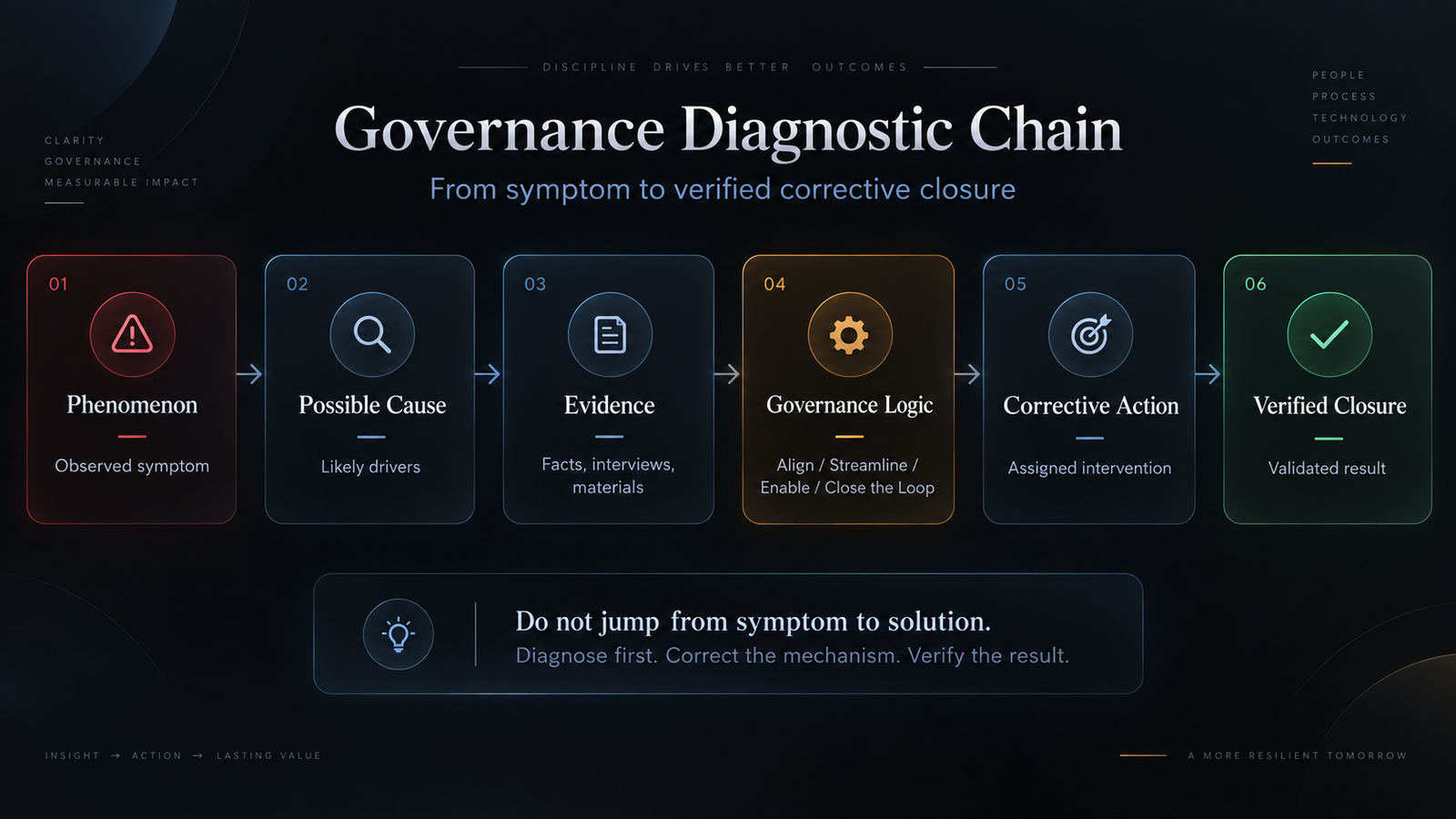
Start from what is observed. Do not assume the root cause.
A symptom is an entry point, not a conclusion. The real cause is confirmed through evidence, interviews, materials, and observation before corrective action is selected.
Phenomenon → Possible Causes → Evidence → Confirmed Cause
The same symptom may come from several different causes. Rework may result from unclear requirements, unclear standards, weak responsibility, or capability gaps.
Governance should therefore avoid “solution first” thinking and establish enough evidence to choose the right corrective mechanism.
Eight standard governance tools convert root causes into actionable correction.
The purpose of the toolkit is not to add paperwork. It is to turn diagnosed causes into structured actions that can be assigned, tracked, reviewed, and closed.
Goal & Scope Confirmation
Clarifies goals, success criteria, non-goals, scope boundaries, confirmation, and later changes.
Requirement & Change Management
Records requirement source, confirmation, priority, status, change reason, and impact.
Standards & Pre-check
Turns vague standards into checkable criteria and exposes gaps before formal submission or acceptance.
Process & Waiting Analysis
Identifies waiting, rework, duplication, unclear handoffs, and actual process bottlenecks.
Responsibility & Decision Authority
Clarifies owner, executor, collaborator, confirmer, decision-maker, and escalation conditions.
Capability & Support Plan
Identifies people, technical, equipment, tool, or method gaps and defines support and validation.
Resource & Priority Adjustment
Addresses shortages through priority changes, scope reduction, support, or phased delivery.
Communication, Decision & Closure
Creates communication cadence, decision records, action tracking, escalation paths, and closure verification.
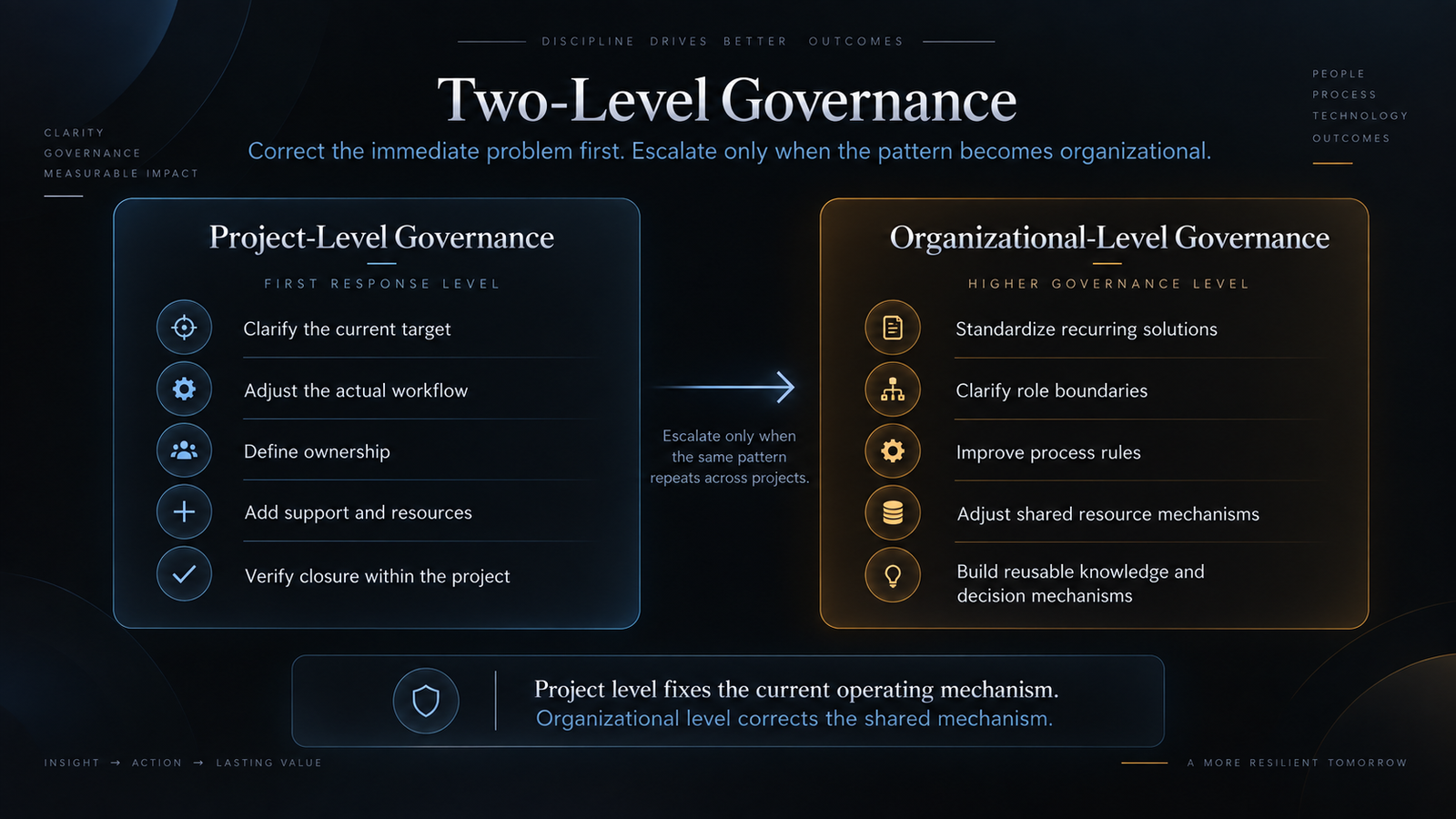
Correct the immediate problem first. Escalate only when the pattern becomes organizational.
The same root cause can be treated differently at project and organizational level. Project-level governance restores the current delivery mechanism. Organizational governance changes the shared rule, standard, role, resource, or decision mechanism.
Fix the current operating mechanism.
Clarify the current target, adjust the actual workflow, define ownership, add support, change priority, record decisions, and verify closure within the project.
Correct the shared mechanism.
Standardize recurring solutions across projects through common templates, role boundaries, process rules, resource mechanisms, decision rights, training, and reusable knowledge.
Governance is complete only when the correction is verified.
A recommendation is not a closure. Governance must leave behind an owner, deadline, action, escalation condition, verification method, and result record.
Issue
Define the actual problem.
Action
Choose the corrective step.
Owner
Assign clear accountability.
Deadline
Define when correction must happen.
Verification
Check whether the mechanism actually changed.
Closure / Escalation
Close with evidence or escalate if unresolved.
Do not manage the symptom forever. Correct the mechanism that keeps producing it.
Integrated governance begins where routine project control ends—and turns recurring dysfunction into accountable, reusable correction.