Enterprise Management System
From strategy execution, to organizational mechanisms, to PMO and enterprise-level collaboration
Enterprise Management System
My understanding of enterprise management is not simply expanding project management to more teams, nor adding more processes, meetings, and reports.
Enterprise management focuses on how the organization operates as a whole: how strategy turns into action, how multiple projects are prioritized and selected, how PMO builds standards and enablement mechanisms, how resources are allocated, and how cross-functional collaboration becomes stable.
For me, the value of enterprise management is to connect strategy, project portfolio, PMO, organizational capability, quality and risk mechanisms, and external value, so the enterprise can reduce friction, produce stable outcomes, and continuously improve.
Core Problems
The Core Problems Enterprise Management Solves
Enterprise management is not only about whether one project is completed. It is about how multiple goals, teams, projects, and resource constraints form overall efficiency.
How strategy turns into action
Translate strategic direction into goals, priorities, project portfolio, resource investment, and management cadence, so strategy does not remain only a slogan.
How project portfolios are selected
Judge which projects should move first and which should adjust cadence based on value, risk, resources, and dependencies.
How PMO becomes a real capability
PMO should not only collect reports. It should build standards, templates, training, resource coordination, project transparency, and review mechanisms.
How departments collaborate
Reduce waiting and repeated communication through goal alignment, responsibility boundaries, dependency management, escalation paths, and feedback cadence.
How quality and risk are built in
Embed quality checks, risk identification, defect closure, release conditions, and review mechanisms into daily operations instead of reacting after issues explode.
How capability becomes value
Turn internal management capability, delivery experience, and service capability into value that customers understand, the market can choose, and the organization can reuse.
How I Understand Enterprise Management and PMO
This video introduces how I see the relationship among enterprise management, PMO, project portfolio, and organizational mechanisms, and how they support enterprise-level collaboration.
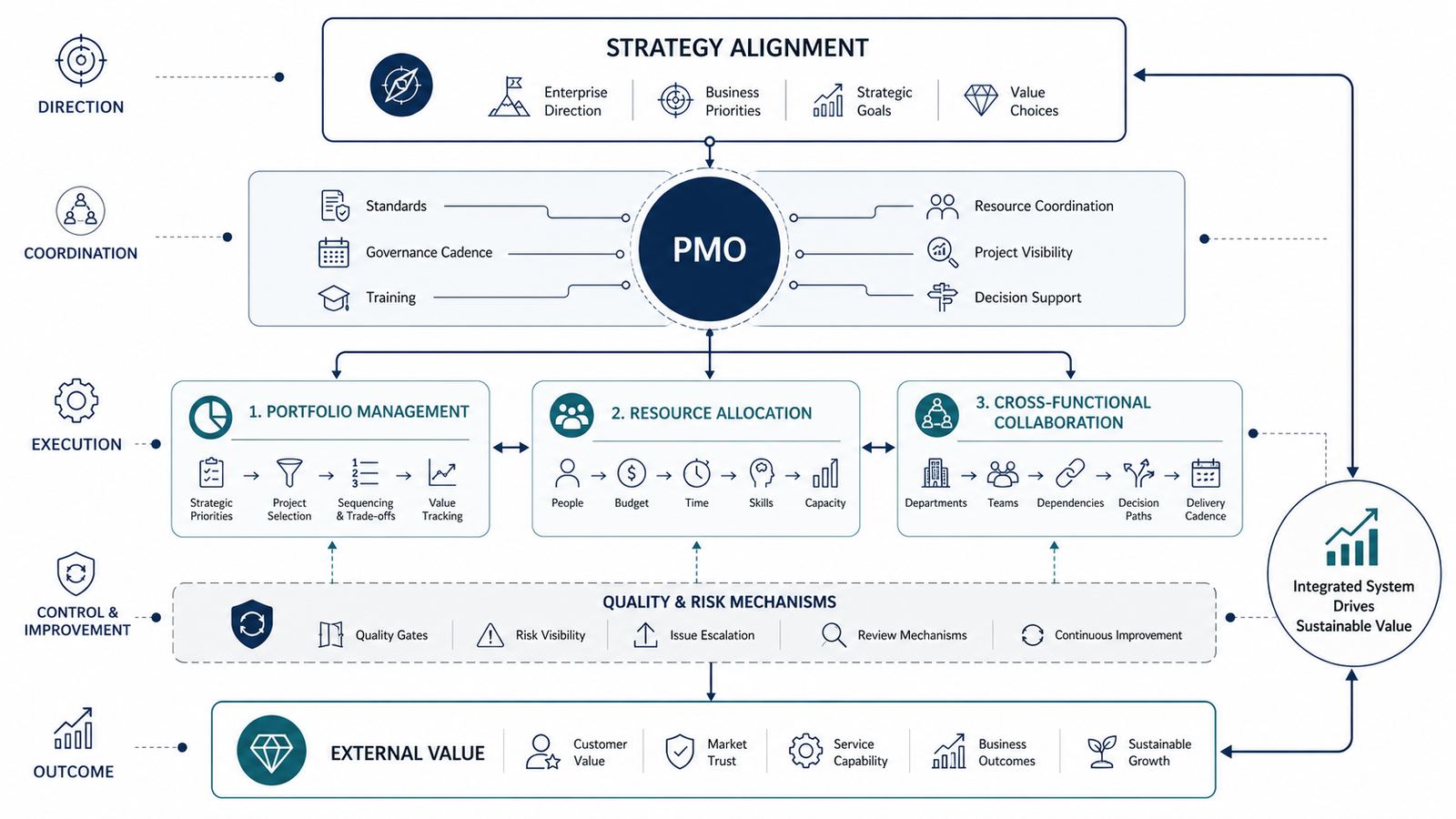
Enterprise Management System Structure Diagram
This diagram shows the relationship among strategy execution, PMO, project portfolio, resource allocation, cross-functional collaboration, quality and risk mechanisms, and external value.
01 / Strategy
Turn strategic direction into goals, projects, and resource choices
Strategy Execution and Direction Management
The first enterprise management problem is how direction lands. If strategy remains only a vision statement, slogan, or annual target, it will not truly influence daily organizational behavior.
The key is to translate positioning, customer value, stage goals, and strategic trade-offs into executable priorities, project portfolio, resource investment, and management cadence.
I focus on the connection between strategy and execution: which goals should come first, which projects support them, which resources must be concentrated, and which low-value work should be reduced or stopped.
Core Focus
- Enterprise positioning
- Target customers
- Value proposition
- Development direction
- Stage goals
- Strategic trade-offs
Management Actions
- Break strategy into executable goals
- Map goals to projects and resources
- Build priority judgment criteria
- Identify low-value consumption
- Help teams understand the real outcomes the enterprise is pursuing
02 / PMO
Move project management from personal experience to organizational capability
PMO and Enterprise-Level Project Management Mechanisms
The value of a PMO is not only checking processes, chasing reports, or collecting progress updates. It should help the enterprise build reusable project management capability.
An effective PMO should unify project language, capture standards, build templates, enable training, manage resource coordination, and make portfolio-level risks and value visible.
In enterprise management, PMO is an important mechanism connecting strategy, project portfolio, resources, risks, quality, and organizational learning.
PMO Mechanisms
- Project management standards
- Templates and checklists
- Training and enablement
- Project portfolio view
- Resource coordination mechanism
- Risk and quality checkpoints
- Reviews and experience capture
Outcomes I Focus On
- Reduce randomness in project management
- Improve cross-project transparency
- Expose risks earlier
- Make resource conflicts visible earlier
- Move experience from individuals to the organization
- Make management standards serve delivery
03 / Portfolio
Manage multiple projects in one organizational view
Project Portfolio, Program, and Resource Allocation
Single-project management focuses on how one project is delivered. Enterprise management focuses on how multiple projects are selected, prioritized, coordinated, and traded off.
In program and portfolio contexts, the real difficulty is often not whether one project is working hard, but goal conflicts, resource conflicts, cross-project dependencies, unclear priorities, and delayed decisions.
Enterprise management needs to place projects into one shared view and clarify their relationship with strategic goals, resource investment, risk levels, and external value.
Enterprise-Level Project Portfolio, Resource Allocation, and Cross-Functional Collaboration
This video introduces how I understand the relationship among programs, portfolios, resource conflicts, priorities, and cross-functional collaboration.
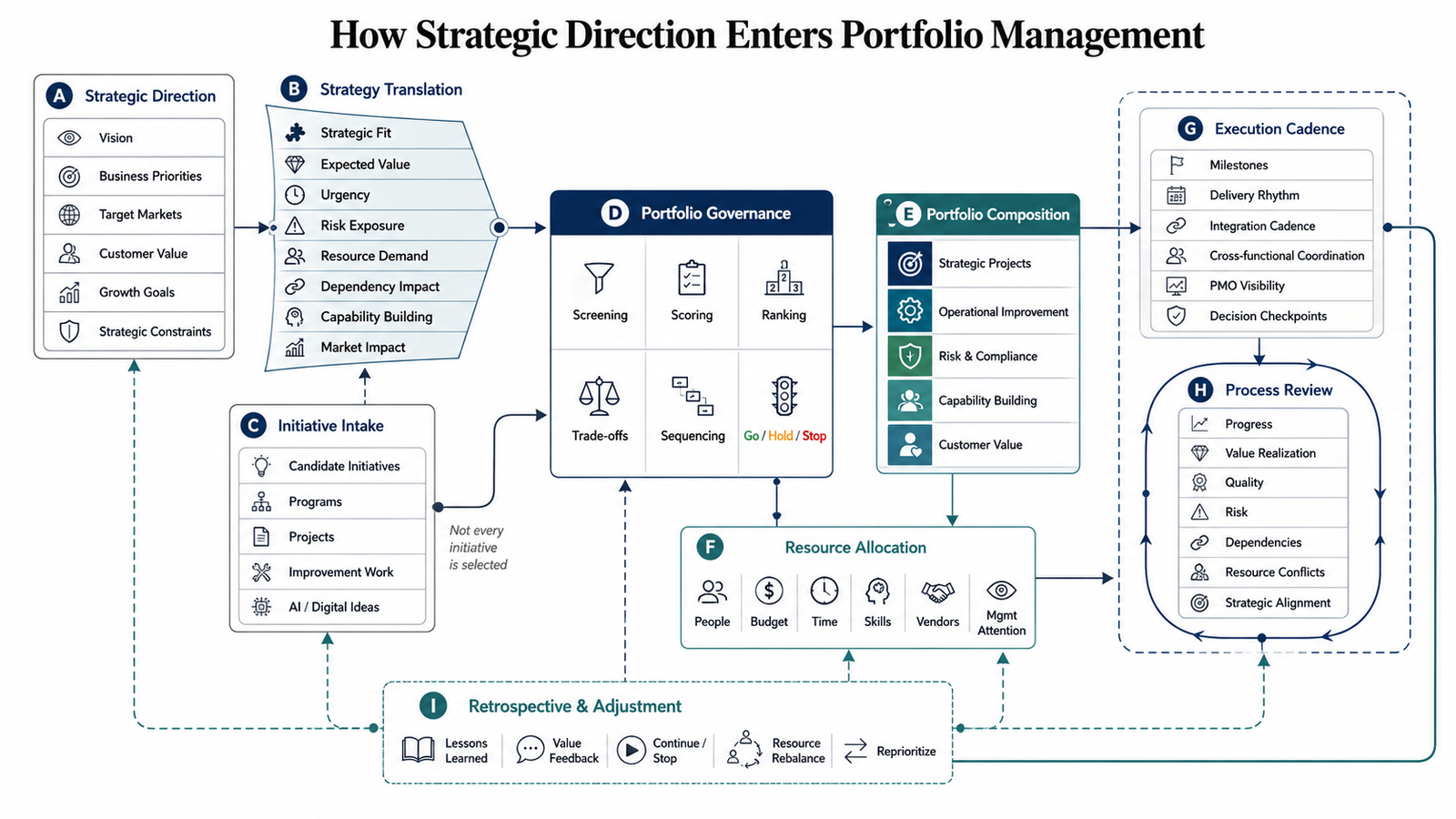
Strategy-to-Portfolio Management Flow
This diagram shows how strategic direction enters project portfolio, resource allocation, execution cadence, process checks, and review-based improvement.
From single-project view to portfolio view
Enterprises cannot only look at whether each project is busy. They need to see whether the portfolio supports strategic goals and overall value.
From resource requests to resource allocation
Resources should not be distributed evenly. They should be allocated based on priority, value, risk, and key dependencies.
From progress reporting to management transparency
Enterprise-level project management needs visibility into risks, dependencies, bottlenecks, resource conflicts, and decision status.
From local completion to overall benefit
Completing one project does not necessarily mean the enterprise goal is achieved. Portfolios need to continuously focus on end-to-end value.
04 / Collaboration
Help departments, teams, and projects collaborate in a stable way
Cross-Functional and Multi-Team Collaboration Mechanisms
Enterprise collaboration is not about inviting more people into more meetings. It is about making goals, responsibilities, dependencies, cadence, and decision mechanisms clearer.
In multi-department, multi-team, and multi-project contexts, a lack of shared goals and dependency management can easily create repeated communication, decision waiting, unclear ownership, and local optimization.
I focus on using cadence, mechanisms, and transparency to reduce internal friction and help teams collaborate around shared goals.
Collaboration Mechanisms
- Shared goal alignment
- Cross-team dependency management
- Responsibility boundary clarification
- Decision escalation path
- Unified communication cadence
- Stage feedback and reviews
Friction to Reduce
- Repeated communication
- Information opacity
- Resource waiting
- Overlapping responsibilities
- Delayed decisions
- Local optimization hiding overall inefficiency
05 / Quality & Risk
Embed quality, risk, and governance into the enterprise operating cadence
Built-in Quality, Risk, and Governance
Quality management should not appear only at the end of a project, and risk management should not start only after issues explode.
Enterprise management needs to embed quality standards, risk identification, stage checks, defect closure, release conditions, and review mechanisms into daily operating cadence.
This is why I do not treat quality management as an isolated page: quality should exist throughout project delivery, PMO mechanisms, governance correction, and enterprise operations.
Shift quality earlier
Use definition of done, acceptance standards, test strategies, and stage checks to expose quality issues earlier.
Make risk transparent
Place key risks, dependency risks, resource risks, and quality risks into a shared view so risks do not stay hidden.
Close issues properly
Issues should not only be recorded. They need clear owners, actions, validation methods, and review cadence.
Improve mechanisms
Recurring issues should become standards, checkpoints, process adjustments, or training materials.
06 / Value
Turn internal capability into external value customers can perceive
External Value and Service Productization
An enterprise cannot only manage internal processes well. It also needs to turn internal capability into value that customers can understand, the market can recognize, and teams can reuse.
Project delivery experience, governance experience, PMO standards, and enterprise management mechanisms can be further captured as service solutions, case assets, standard products, and reusable methods.
This conversion allows the enterprise not only to complete individual projects, but also to continuously accumulate capabilities that customers can perceive and choose.
External Expression
- Market positioning
- Customer value expression
- Case assets
- Service standardization
- Service productization
- Partner management
Value Conversion
- Turn delivery experience into service solutions
- Translate management capability into customer language
- Turn project outcomes into case assets
- Turn temporary services into standard products
- Turn organizational capability into market trust
How Enterprise Management Turns Experience into Mechanisms
This video introduces how enterprises can capture project experience, PMO standards, governance correction, and organizational capability as reusable mechanisms and convert them into external value.
AI Enhancement
The Role of AI in Enterprise Management
AI capability is an independent direction, but in enterprise management it can also become an enhancement layer for PMO, knowledge management, risk analysis, and organizational collaboration.
Management Scenarios AI Can Enhance
- PMO standards knowledge base
- Project portfolio information structuring
- Meeting notes and action item extraction
- Risk and issue summarization
- Project review material generation
- Training material and template retrieval
Governance Boundaries to Keep
- Important judgments require human review
- Sensitive data should consider private environments
- AI output cannot replace accountability
- Automation level should match risk level
- AI usage needs policy and access boundaries
Keywords
My Enterprise Management Keywords
Strategy Execution
Turn direction into goals, projects, resources, and daily management cadence.
PMO
Move project management from personal experience to organizational standards and capability.
Portfolio
Manage multiple projects from the perspective of overall value, resources, and risks.
Collaboration
Help departments and teams reduce friction around shared goals.
Quality and Risk
Embed quality, risk, and governance into enterprise operations.
External Value
Turn internal capability into value customers can understand and choose.
My Enterprise Management System is not designed to make the organization look more complicated. It is designed to make the enterprise operate more clearly, stably, and efficiently.
It focuses on how strategy lands, how PMO becomes a real capability, how multiple projects collaborate, how resources are allocated, how quality and risk are built in, and how organizational capability continuously turns into external value.
For me, the core of enterprise management is not adding more management actions, but reducing organizational friction and enabling the enterprise to continuously produce results.